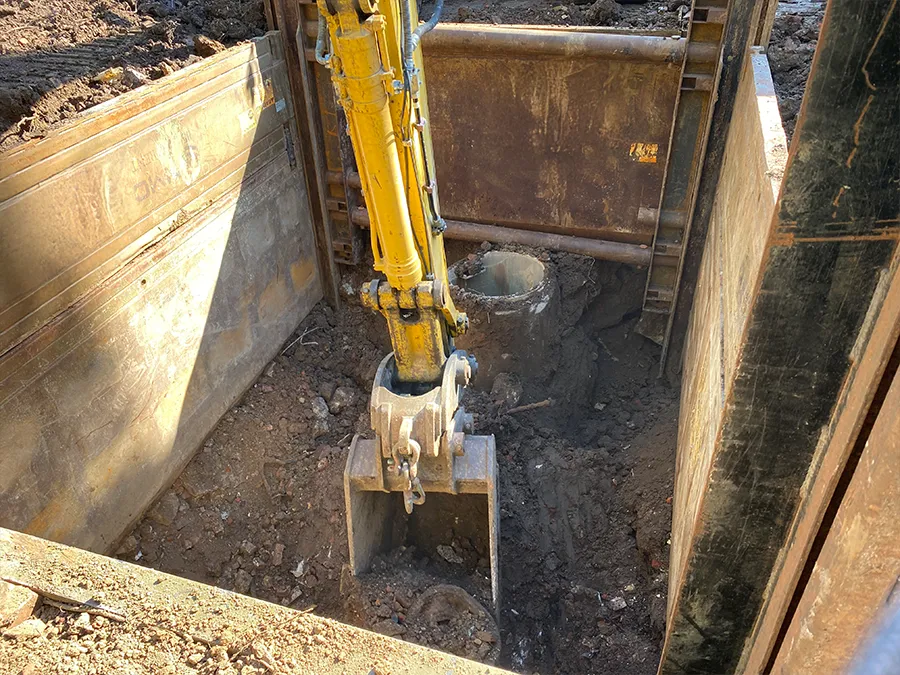
Whenever weather conditions change in the slightest, the CP should be inspecting the soil for changes.
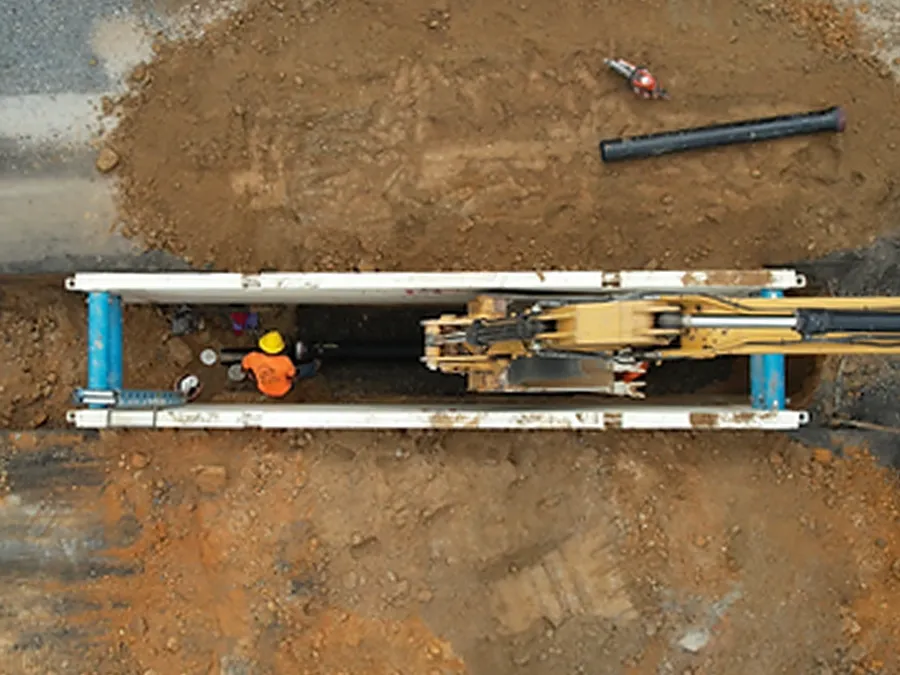
trenching and shoring protection for your crew

Summer rains can create several challenges when it comes to building a trench and then maintaining trench safety. A cave-in can happen in a matter of seconds, seriously injuring, even killing, a worker. Therefore, it is critical to know how to handle the extra moisture in order to keep your crew safe this summer.

Understanding the Dangers of Trenching and Excavation

OSHA states that trenching and excavation are among the most hazardous construction operations. Cave-ins pose the greatest risk as they result in more worker fatalities than any other type of excavation-related accident. Dozens of workers die each year as a result of cave-ins.

The U.S. Bureau of Labor Statistics shows that there were 36 excavation or trenching cave-in deaths in the U.S. in 2016. The majority of these injuries occurred in the construction industry. It’s important for workers to understand that any excavation has the potential to cause serious injury or fatality. Systems must be in place to prevent accidents such a cave-ins. Once in place, these precautions must be carried out consistently.

The Job of the Competent Person

Wet weather can quickly change what’s safe and what is not. When it rains, the water can make the sides of the trench less stable. OSHA requires that trenches must be inspected daily and as conditions change by a CP (competent person). This person is one who is capable of identifying existing problems and also predicting potential problems.

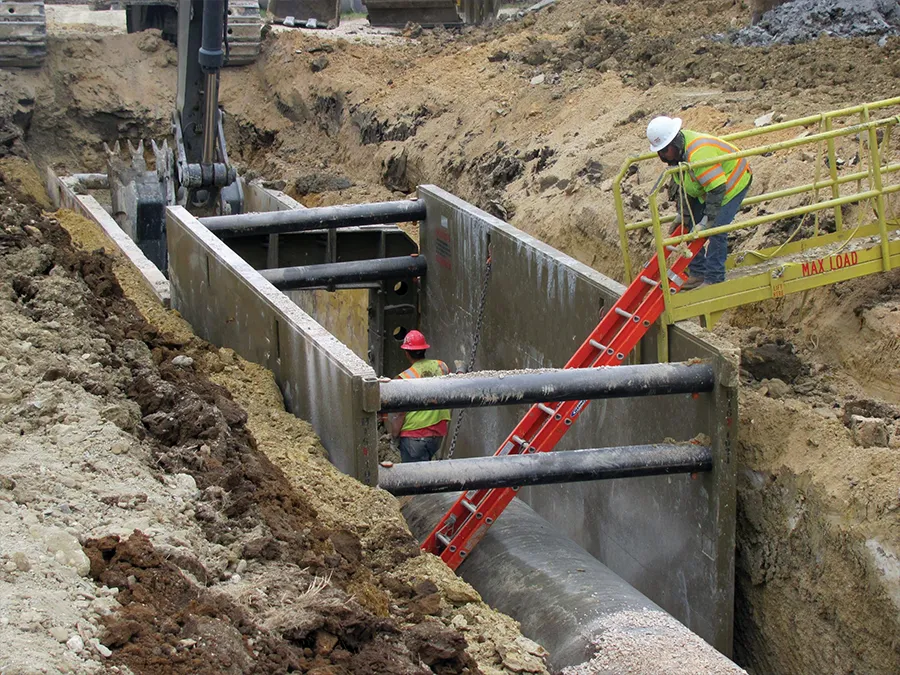
The CP will ensure that the crew is using their protective systems and that they are set up correctly. They will make sure that workers aren’t taking chances, that the ladders are set up properly, and that everything else that goes along with keeping the trench safe is in place before a worker enters it.

According to OSHA 1926.651(h)(1), employees are not allowed to work in excavations in which there is accumulated water, or in excavations in which water is accumulating, until the CP inspects the excavation and stabilizes the trench somehow. Using a trench box is the quickest and easiest way to support a trench wall. Also, the CP needs to take action to remove the water, such as using a pump. If a pump is used, the CP has to make sure it is working properly.

Finally, Inspect! Inspect! Inspect! Whenever weather conditions change in the slightest, the CP should be inspecting the soil for changes. It could alter the protective system that is used, such as if a contractor is using hydraulic shores and water makes the trench walls unstable, shores cannot be used. If a contractor is sloping a trench, as soon as water gets into the trench, the angle of the slope needs to be flattened.

Additional Safety Tips

Other general trenching and excavation rules stated by OSHA include:

  • Keep heavy equipment away from the edges of the trench
  • Do not work under raised loads
  • Determine where underground utilities are located
  • Keep surcharge loads at least 2 feet away from the edges of the trench
  • Test the area for hazardous fumes, toxic gases, and low oxygen
  • Inspect trenches at the start of each shift
  • Inspect the trench after heavy rainfall

St. Louis Trenching and Excavation

At Luby Shoring Services, we are experts in trench shoring and excavation projects. We have the expertise to work with you on site specific engineering services. We can quickly complete any job while meeting OSHA safety regulations.

In addition, we provide a wide selection of standard and custom trench shielding and shoring options. Our equipment is cost effective, safe and versatile, relied upon by underground utility professionals, municipalities and private contractors. All products are Professional Engineer certified to help you meet OSHA’s excavation and trench safety standards.
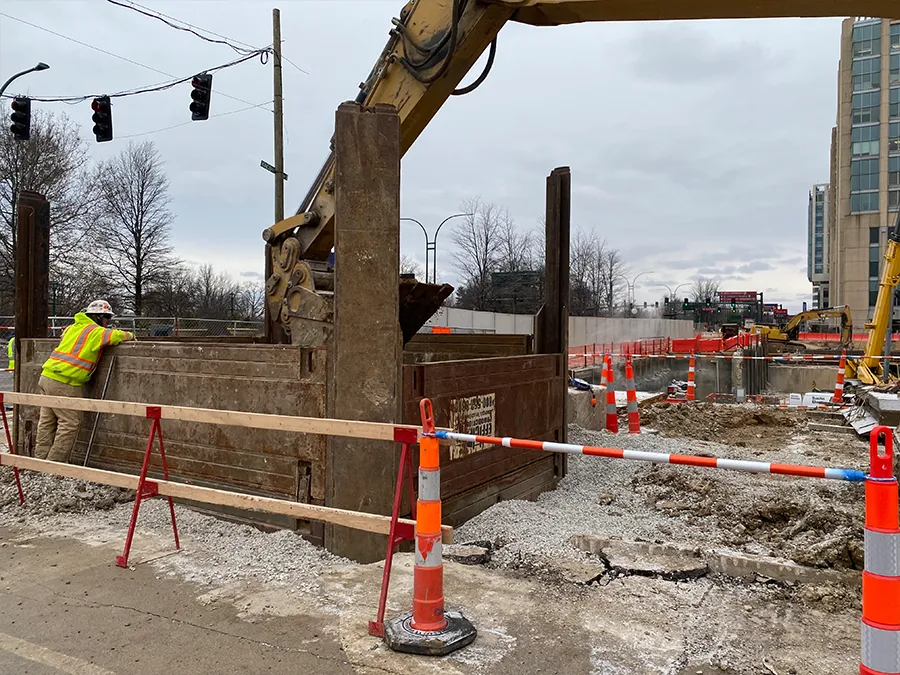
Let Luby Shoring Services help keep your workers safe this summer! Call us at (636) 660-7467.

There are certain techniques in the trenching industry that will help to keep your work-site and your employees safe.

In the construction industry, which is already fraught with hazards and dangers, trenching is one of the most hazardous environments that anyone can work in. Trenching is used to hold up the integrity of a job site or a building to give it stability. While rules are in place to deal with trenching sites and government agencies like OSHA are in charge of monitoring, accidents still occur. When regulations are not followed or there is not sufficient training provided, it can lead to severe work injuries.

There are some techniques in the trenching industry that will help to keep your work-site and your employees safer when working around trenching and shoring equipment and projects.

tips and tricks for safer trenching and shoring

Dewatering Utilizing Well Points

One of the biggest hazards of any trenching site is water. When you excavate a site, the key is to minimize any standing water, which can eat away at the integrity of the trench. To eliminate standing water, digging well points to drain is an excellent way to maintain the trench. Once a hole is dug into the ground, insert a pipe and a submersible pump to remove water, especially in sandy soil. The best time to implement this type of water control is three to five days before the excavation even begins. Otherwise, surrounding groundwater will start leaking into your working site. Also, make sure that you place the well points effectively and have the right number of them to accommodate for any water that results from the excavation.

Improving Working and Walking Surfaces

One of the most common ways for someone to hurt themselves in a trenching accident is by slipping and falling. To improve working and walking surfaces, it is important that you make sure that the trench floor is perfectly level for workers. Any dips can lead to someone losing their balance. Another way to improve walking and working surfaces is to add or spread rocks. Not only will the rocks help with drainage, but they will also make surfaces less slick.

The Competent Person

A competent person is an individual who has the capacity to identify the predictable and existing dangers in the workplace. He can clearly perceive the working conditions which are hazardous or unsanitary and pose a risk to the workers. He has the ability to identify the types of soil and design suitable protective systems. He possesses the authority to implement corrective measures to get rid of the hazards.

Trenching is a dangerous practice in the construction industry. To ensure that your worksite is safe for your employees and to keep things running smoothly, an ounce of prevention is totally worth it. Make sure to factor in things like the skill level of the management you hire, the working surfaces, and how to accommodate for different soils to keep everything running on time and as planned.

St. Louis Trench Shoring Services

With more than 70 years of experience, trust Luby Shoring Services. We strive to provide reliable service, proven innovative shoring and shielding products, and an experienced staff to supply working solutions for your project’s specific needs. Call us today at (636) 660-7467 or fill out our online contact form.

Only someone who understands the complexity and hazards of cave-in accidents can help to keep everyone at the worksite safe!

Trenching is one of the most hazardous practices in the construction industry. When a structures’ integrity is compromised and needs to be repaired, or a building is being constructed and needs to have safety guards in check to keep the walls from collapsing, trenching is the practice that helps keep everyone safe. But trenching is only safe if done properly. Cave-ins are common in the construction industry. They can be highly destructive to the construction site and to the trench workers.

how to prevent trenching and shoring injuries

What are the common reasons that trenches cave in?

Soil is held up is by the force placed upon it by the soil next to it. This means that when trenches are dug, the soil that was holding up the surrounding walls of the trench can be compromised, and there is no force placed on it to hold it up. That leaves a vertical wall of soil with no opposing force to keep it upright or to lend it support. That is why some trenches fail to stand and can lead to cave-ins. 

Protective systems and methods for excavated soils

The Occupational Safety and Hazards Administration is the government agency tasked with protecting trenching workers. OSHA employees work at the state level, and their purpose is to protect workers from serious construction site injuries. OSHA’s rules state that a trench must be dug a minimum of five feet into the soil to prevent the risk of a cave-in.

They also require that employees be trained about the importance of the protective measures set in place by OSHA — not just to the job site, but to their safety. The safety systems that are commonly employed are:

  • Benching or sloping of the soil – One of the simplest methods to protect trenching workers, benching is when the walls of the excavation are either sloped or benched, depending on the type of soil in place at the site. As the soil and its stability are reduced, so is the angle at which the trench is sloped. If conditions are not safe for benching or sloping due to the soil conditions, shoring or shielding must be used.
  • Shoring – Shoring is a system that provides lateral support to oppose the force of the wall to prevent it from collapsing. It involves either timber or metal uprights through sheet piling or other accepted methods. As shoring is used to protect larger worksite areas, crews can typically work inside or next to the excavated site without fear of a cave-in accident.
  • Shielding – Unlike shoring, shielding isn’t a system used to prevent a cave-in of trench walls, it is used to protect employees from having specific areas of the trenching site cave in on workers. Most commonly called “trench boxing,” it is designed specifically for workers’ protection and can be moved around the trenching site.

The type of system that is most effective to prevent cave-in accidents in any trenching worksite depends on many factors. Only someone who understands the complexity and hazards of cave-in accidents can help to keep everyone at the worksite safe and to keep your construction site working efficiently and safely for everyone.

Luby Shoring Services

When it comes to excavating projects, rely on Luby Shoring Services’ expertise. We will help you complete any job quickly, while meeting OSHA safety regulations. We have a wide range of options available for fast delivery, and our team will provide options for the correct equipment to use with your job.

Our team will pair your job with the right trench shields and shoring products. Call us today at (636) 660-7487 or fill out our online contact form.

To prevent accidents, it is best to avoid these most common trenching mistakes.

When it comes to construction, there are fewer jobs more dangerous than trenching and shoring. Trenching and shoring are both done to safeguard the integrity of a structure that might not otherwise be safe.

Providing bracing by using the area around the structure, trenching operations are adequate ways to work around buildings until the structure is safe again. The problem with trenching is that many things can compromise the safety of both workers and the work site. To prevent accidents, it is best to avoid these most common trenching mistakes.

prevent shoring and trenching hazards with these tips

Mistake 1: Not Doing the Research

It might seem like a simple thing, providing a shield while you work. But when it comes to dealing with soil conditions, weather, water, and all the other things that can compromise the safety of a trenching structure, you simply can’t plan too much. Make sure to accommodate for anything that can go wrong – because when it comes to construction and trenching, it likely will. And when it does, it isn’t just an oops, it has the potential to cause serious injuries – and in some instances, death.

Mistake 2: Don’t Misjudge Things

If you always err on the side of things going your way, then you are going to get into trouble. For trenching sites, the only way to ensure that no one gets hurt, your operation doesn’t get behind or shut down, and that things go as smoothly as possible, is to anticipate the worst-case scenario and plan for it. If you think that the worst can’t happen, then you aren’t going to be prepared when it does. When it comes to construction, everything unpredictable is predictable; if you want to keep everyone safe, then that is the theory you have to live by.

Mistake 3: Not Using the Right Equipment

Shoring and trenching equipment can cost a lot of money. But if you don’t dig correctly or set up your trenching work site appropriately, the potential consequences far outweigh the cost of renting the right equipment or hiring someone to do it right. When it comes to trenching, don’t save pennies by spending dollars. The number-one priority should be to keep your workers safe and to be on schedule without any major hiccups. Sometimes paying the money up front to make sure things go right is well worth it, and better than to end up paying for the mistake of not doing it correctly.

St. Louis Trenching Company

Trenching can be a very dangerous practice in the construction industry. If you don’t shore things up correctly and build a safe work site for everyone, you not only risk the safety of your employees – you also can jeopardize being on track, paying for an injury, and not securing the job site to run as efficiently as it should. Sometimes you have to put in the additional cost, effort, and research to ensure that your outcome is what you want and that everyone is safe. To make sure that you are doing everything to code and keeping everyone safe, contact a St. Louis trenching company to help you devise the best plan to make your construction project run smoothly.

Experts in trench shoring and excavation projects. Call Luby Shoring Services at (636) 660-7467.

To keep workers safe don’t set unrealistic goals or offer incentives for things to get done quickly or under budget.

Trench Safety St. Louis

Trenching is considered a highly-dangerous occupation in the construction field. The reality is that just one yard of cubic dirt can weigh as much as 3,000 pounds, which is enough to crush a worker or trap him underneath if the trench is compromised and gives in. That is why having the proper safety measures in place is so crucial to keep everyone safe on a trenching site.

Why Trench Safety is So Important

Fatal trenching incidents have as much as doubled in just the last year. OSHA, the Occupational Safety and Health Administration, insists that if better safety measures had been implemented, most of those accidents would not have happened. If trenching companies would do a better job of keeping sites safe, then the number of accidents would decrease significantly. Keeping your job site safe is not only a moral obligation, it is also a law. If an accident happens, it is possible for those in charge to face criminal charges.

Setting Realistic Time Frames

One of the biggest reasons that things go wrong is because trenching workers are often on tight schedules to get jobs done. When they are in a time crunch, it is not uncommon for them to cut safety corners to finish on time. That can lead to workers and managers being careless and making decisions based on time efficiency, rather than on the safety of employees. Make sure to set realistic goals when you are running a trenching operation. Scheduling strict time frames that are unrealistic will only jeopardize your workers and increase the likelihood of accidents.

Another reason that things go awry and workers get hurt is that supervisors and managers are often given incentives in the form of bonuses for getting a job done on time or even ahead of schedule. To cut costs, supervisors will bend the rules or put workers in riskier positions to get goals met and to reap the benefit. As a trenching company, you do want to set goals and to offer an efficient operation, but offering your supervisors and managers money to get it done quickly might not be the best way to ensure the safety of your overall operation.

Finally, it costs more to do things right. Having the proper safety measures in place is a little costlier for the company and hiring safety managers might seem like an additional cost that can hurt a company’s bottom line. But what will really put a kink in your budget would be if your operation was shut down, you are fined, or someone gets hurt and you face criminal prosecution.

Trenching is a highly dangerous but necessary component of construction. If you want to keep your workers and your operation safe, then don’t set unrealistic goals or offer incentives for things to get done quickly or under budget. Invest in your workers, and they will invest in your company. It will also ensure that the job gets done right and that everyone is much safer.

Call Luby Shoring Services at (636) 660-7467 or Fill Out Our Online Contact Form.